Millets: The Forgotten Grains Your Grandma Was Right About
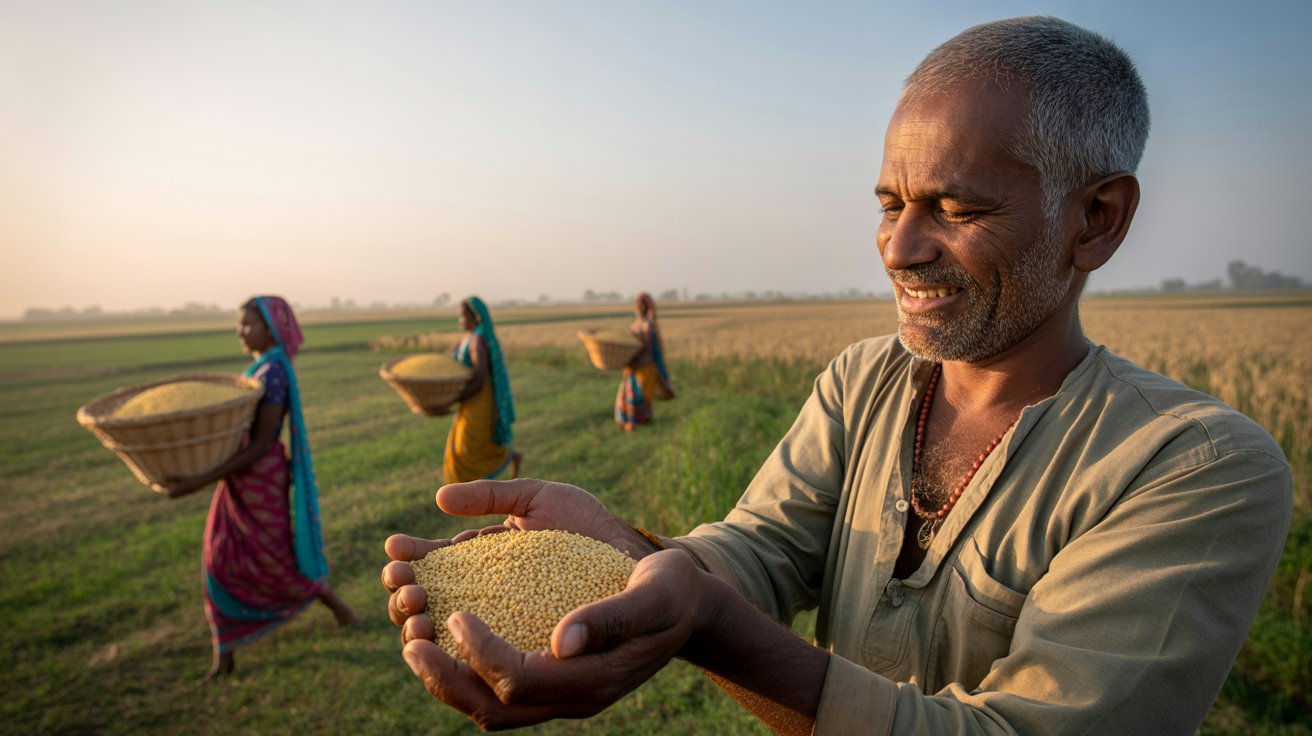
Meet Guddu Singh, a farmer from rural India who was struggling with his land. Nothing grew well. Then he tried millets. Today, his once-barren field produces healthy crops with barely any water, and his neighbors are lining up to learn his secret[1].
That’s the magic of millets: the tiny grains making a mighty comeback.
India’s Millet Power
Here’s something to brag about at your next dinner party: India produces 38.4% of the world’s millets, more than any country on earth[6][1][2]. In 2024-25, we grew 18 million tonnes across our farms[1].
Rajasthan leads with 27% of production, growing bajra in its deserts where other crops simply give up[5][3]. Karnataka follows with ragi that locals lovingly turn into ragi mudde ; comfort food that’s actually healthy[5][3]. Maharashtra keeps the jowar bhakri tradition alive with 14% of production[5][3].
The Numbers That Matter
Let’s cut to the chase. One serving of ragi has 344 mg of calcium, more than milk. Rice? Just 2mg[9][10]. Pearl millet contains 10 times more iron than rice[9][10]. If you’re vegetarian and tired of feeling tired, these numbers should excite you.
But here’s the jaw-dropping part: producing 1 kg of rice needs 5,000 liters of water. Millets? Just 650-1,200 liters[11][12][13]. That’s like comparing a water-guzzling SUV to an electric scooter. If we replaced just 10% of our rice with millets, India would save 545 trillion liters of water[13]. Read that again.
The Catch (There’s Always One)
Millets contain antinutrients that block mineral absorption[14][15][16]. Sounds scary? Your grandmother already solved this centuries ago. Just soak them overnight or ferment them (like you do for dosa), and these antinutrients drop by 60%[16]. Traditional wisdom beats modern problems every time.
Cost is another hurdle. At ₹20/kg average, millets cost more than subsidized rice[17]. But when you factor in water saved, emissions prevented, and health benefits gained, millets are actually 1.6 times cheaper than rice[18]. Sometimes the real cost isn’t on the price tag.
Why This Matters Now
Climate change isn’t coming… it’s here. Droughts are increasing. Water tables are falling. And millets? They laugh at 60°C heat, thrive in poor soil, and are ready in just 70-80 days[19][20][13]. By 2050, switching to millets could save India 50 million tonnes of greenhouse gas emissions [21].
The Indian government is backing this with ₹800 crore schemes[22][23]. We exported $37 million worth of millets in 2024-25[1]. The world is watching.
Your Move
Start small. Swap one rice meal per week with ragi dosa or jowar roti. Soak overnight for better taste and nutrition. Check your local store, many now stock multiple varieties.
As Guddu Singh discovered on his struggling farm, sometimes the solution to tomorrow’s problems lies in yesterday’s wisdom. His neighbors thought he was crazy to plant millets. Today, they’re asking for seeds.
Your grandmother knew what she was doing. It’s time we listened.
The future of food is actually 10,000 years old. Are you ready to taste it?
Citations
[1] Empowering India through Millets – PIB
[2] Indian Millets – APEDA
[3] Largest Millets Producing States in India 2025 – Top 10 List – Testbook
[4] Millet Production by Country 2025 – World Population Review
[5] Top-5 Millets Producing States in India in 2025 – Current Affairs
[6] Millet Farming in 2025: Why the World is Looking at Indian Farmers?
[7] Millets’ Status in India: An Integrated Assessment for Harnessing
[8] Millet | USDA Foreign Agricultural Service
[9] The Nutrition and Therapeutic Potential of Millets
[10] Millet – Wikipedia
[11] Growing Millets for a Sustainable Future
[12] The Environmental Benefits of Millets: Sustainable Farming
[13] Millets: Rediscovering Ancient Grains for a Sustainable and Nutritious Future
[14] Antinutritional Factors in Pearl Millet Grains
[15] Physiochemical, Bio, Thermal, and Non-Thermal Studies on Millets
[16] Insights of Nutritional and Anti-Nutritional Retention in Millets
[17] Millets Mandi Price
[18] Promoting Millets in the Public Distribution System – TCI
[19] Reviving Resilience: Millets as the Climate-Adaptive Crop
[20] Millet’s Role as a Climate Resilient Staple for Future Food
[21] Shift from Rice to Millets, Save 50 Million Tonnes – TOI
[22] Centre’s PLI Scheme to Boost Millet-Based Products
[23] Promotion of Millet-Based Products – PIB